
GLOBAL NEWS
FDA announces fees for FY 2027
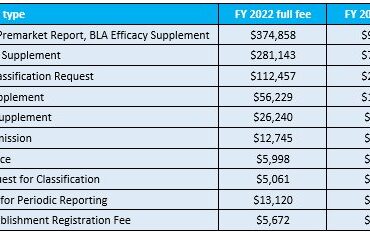
The US Food and Drug Administration (FDA) Center for Devices and Radiological Health (CDRH) has published the user fees applicable to submissions, etc for fiscal year 2027, running from 1 October 2026 to 30 September 2027. The new fees represent between a 10% and 20% increase over the 2026 fees. Further details are available from…
MDCG Position Paper published on Management of SSCP/SSP in EUDAMED
The EU Medical Device Coordination Group (MDCG) has published a new guidance document, MDCG 2026-4, titled ‘MDCG Position Paper: Management of SS(C)P in EUDAMED after mandatory use’. The document explains that “The summary of safety and clinical performance and the summary of safety and performance (SSCP and SSP respectively), are to be uploaded by the…
FDA drafts new rule on use of electronic instructions for use
The US Food and Drug Administration (FDA) has released draft wording for a new rule that would allow gretaer use of electronic instructions for use for many types of medical device. The proposed rule, if finalized, would clarify that the “adequate directions for use” requirement under section 502(f) of the Federal Food, Drug, and Cosmetic…
FDA publishes guidance Q&A on Clinical Support Software
The US Food and Drug Administration has recently published a Q&A document on the subject of Clinical Support Software, following release of full guidance on the topic in January 2026. The Q&A explains that “Clinical Decision Support (CDS) software are important tools in modern health care. While some CDS software has been excluded from the…
EU Delegated Acts on well-established technologies published
Two delegated acts on well-established technologies (WET) under the Medical Device Regulation (MDR, 2017/745) have now been published in the Official Journal of the EU. Well-established technologies are relatively simple devices, with common and stable designs that don’t evolve significantly, have well-known safety and clinical performance characteristics, with a long history on the market. The…
FDA Updates Lists of Medical Devices that Incorporate Digital Health Technology
The US Food and Drug Administration (FDA) maintains publically available lists of safe and effective medical devices, including devices that incorporate digital health technology. The Agency has recently updated its searchable lists of such devices, including Artificial intelligence (AI) Augmented reality and virtual reality Sensor-based digital health technology The FDA lists are not comprehensive resources…
MHRA Announces Intention to Join MDSAP
The UK Medicines and Healthcare products Regulatory Agency (MHRA) has announced its intention to move towards full membership of the Medical Device Single Audit Program (MDSAP), the international scheme that allows a single quality management system audit to satisfy the regulatory requirements of multiple participating regulatory agncies. At present, MHRA is an official observer of…
EC gives medtech five years to adopt revised symbols standard
Following the November 2025 publication of Amendment 1 to EN ISO 15223-1:2021, the medical device industry has been concerned about the timescale for introduction of the revised symbol for ‘Authorised Representative’, which changes from EC:REP to EU:REP. The standard with its amendment has now been harmonised and so is suitable for conferring a presumption of…
FDA publishes final guidance on human factors information in marketing submissions
The US Food and Drug Administration (FDA) has finalised its guidance titled ‘Content of Human Factors Information in Medical Device Marketing Submissions: Guidance for Industry and Food and Drug Administration Staff,’ superseding the draft released in December 2022. The guidance provides a risk-based framework to guide manufacturers and FDA staff on the human factors information…
Four EUDAMED Modules are now mandatory
28 May 2026 marks a major milestone for the European medical devices’ regulatory framework, as four modules of EUDAMED are now mandatory to use, these being: – Actors – UDI/Devices – Notified Bodies & Certificates – Market Surveillance The long overdue use of EUDAMED is intended to enhance transparency, traceability, and regulatory cooperation across the…